Tuesday, May 19, 2009

Roof and Stairs


the roof of the structure will either be the main entry of light from outside or will be completely solid so as to concentrate on the light entering from the side galss panels. the materiality will be balsa.


The balsa will have to be steamed so as to achieve the curving nature of the structure.


Another idea is that the roof will consist of many different openings. Some will be closed off at the start - at the front where the room is most claustrophobic. Then will slowley open up with light to reflect the opening up of the rooms symbolising the artists enlightenment.


the movement of one space to another will be dictated by stairs leading up - stairs opposite are a good idea as the depict a tumultuous journey.

Doors, Windows and Openings


The entrance to this 'dreamworld' structure takes some thinkning about. The opening above by Carlo Scarpa is interesting in that the interlocking of the two circles could be representational of interlocking the two states of reality and escape from reality.


The partitions between the room will be made of a harsh material to contrast the soft materials of wood and glass that cocoon the inside space. Each partion will have an opposite image.

As the rooms progress and the space becomes larger, so do the openings that lead you to the next space.


Underground vs Above Poches

Having an above walking route and below walking route will symbolise the choice of reality and dreamworld. Openings will enter into the underground route which will evoke an interplay of light and shadow.


Underground spaces - exploring the contrast and juxtoposition of dark and light - claustrophobic and open.
The spaces will be cut into the earth - raw and natural.
Spaces may have a connection from one another - underground tunnel (see sketches below)

Dark and Light Spaces


Patterns of light and dark affect both our perceptions of the world and our emotional and physiological responses, and thus they are essential in gathering information about the physical world.

Our perception of architecture will be influenced by light:
– Light defines zones and boundaries,
– Light expands and accentuates rooms,
– Light creates links and delineates one area from another,
– Light create impressions of a space


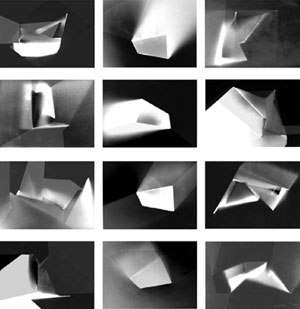
Projections of a small simple modell. Permutation of states of light and shadow taking territory of each other.


Light and dark are relative perceptions of light. Architects use the concept of light and dark as they create visual interest on a building by choosing shapes that create a sensation of depth. When some shapes stick out, they leave others in shadow. Narrow openings often appear dark, as in a tunnel, and broad, flat spaces look light. Materials can be used to vary the light quality of a building. For instance, a band of tinted windows gives the illusion of a dark space wrapping around a building.


Monday, May 18, 2009

Ideas for Project Two


Narrative


Edward Hopper -Evening Wind (1921)

Whitney Museum of American Art: New York, NY; and National Gallery of Art: Washington, D.C.


'The young girl in a desperate need to escape her hostile and claustrophobic reality unlocks her mind to plunge into a safe and free dreamworld.'

Words that express the etching:
Exposed

Sensual
Black - White
Contrast
Night-Day
Vulnerable
Self-awarness

Surprise
Discovery
Modesty
Release

Drama
Movement
Re-birth

Organic


Villa Savoye

Villa Savoye represents an innovative house type whose design concept has achieved dual status: an assertion of classical values - the temple that surveys the landscape and the contemporary paradigm of a modern dwelling.

-Floating Box
- Similar to a purist paining - a pattern of volumes and patterns that generate impeccable proportions.

Programme - Responds to a bourgeois country retreat.
- Servant area on the bottom (for Le Corbusier he was foreseeing an end to this era - he saw them becoming redundant and machines taking over domestic tasks)
- - However, went ahead and the distribution of space is very well conceived. All rooms open on to exterior- glazed windows flood it with light while the spiral staircase links all the rooms with living quarters above.
- The ramp is an essential part as where the staircase separates the floors from one another the ramp instead links them together.


PARTI DIAGRAMS


The Villa Savoye is considered by many to be the seminal work of the Swiss architect Le Corbusier. Situated at Poissy, outside of Paris, it is an iconic architectural example of early modernism, the so-called International Style. Construction was completed circa 1929 but fell into disrepair during World War II. It has since been fully restored and is open for viewing.
The house addressed "The Five Points", his basic tenets of a new aesthetic of architecture:
-The pilotis, or ground-level supporting columns, elevating the building.
-A flat roof terrace reclaims the area of the building site for domestic purposes, including a garden area.
-The free plan, made possible by the elimination of load-bearing walls.
-Horizontal windows provide even illumination and ventilation.
-The freely-designed facade, unconstrained by load-bearing considerations, consists of a thin skin of wall and windows.

THE MODEL


The design of the house goes against the traditional codes of residential architecture, instead it is a representation of a new vision in the form of functional architecture. Vertical circulation is facilitated by ramps as well as stairs and the geometry of the house is designed to ensure that as people move through the spaces they experience the harmony between the architectural forms and the play of light.


Given that Villa Savoye is an excellent example of Le Corbusier's Machine for Living ideal-- it is no surprise that there were a number of mechanized processes to ease standard jobs. For instance, in many of his buildings one will see the lever used to crank open large windows and doors, such as the one that exists in the sun room at Villa Savoye.
In the sun room one will also notice the piloti that passes through the fireplace within the room. Le Corbusier succeeded in allowing these supports to transfer through the spaces unobtrusively. Much as the structural necessity of the pilotis did not bother him, nor did he try to hide them, he also allowed numerous radiators to show throughout the home. From the sun room, one has a good look out onto the second story terrace and the ramp leading to the roof garden.
Furthermore, in the kitchen, he carried through with his efficient life schemes in the use of cabinets which slide open on either side. The utilitarian kitchen is white in contrast to the almost decadent master bathroom with its aqua tiled bath tub.